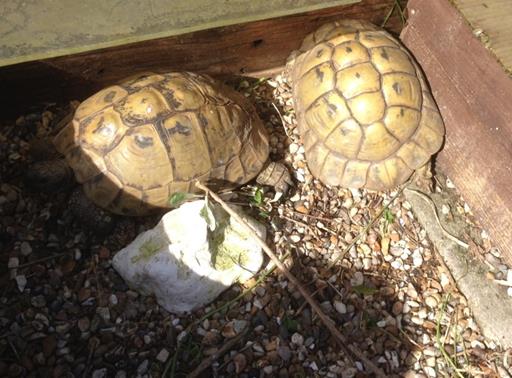
Creating suitable environmental conditions in a British garden Mediterranean tortoises are those most commanly found as pets in the UK. There are three main species, the Spur-thighed (Testudo greaca), the Hermanns (Testudo hermannii) and the Marginated (Testudo marginata). More recent importations of, for example Horsfields tortoises, and the tropical species. They all have one vital environmental requirement; a much warmer climate than that found here. You will not see any of these species recorded as surviving in the wild in Britain, because they are not native. Our climate is not warm enough for reptiles of their size to survive, and they are only here having been imported for the pet trade. If they are to survive and remain healthy, we need to create conditions which are as similar as possible to their native habitat. This means providing them with outdoor accommodation during the Summer months, in a safe tortoise garden. The garden should have an area which is warm and dry at all times. |
Position of the garden The garden, within a garden, for tortoises should be in a sunny position, with some parts of the enclosure receiving sun throughout the day. This is particularly important in the early morning. Tortoises will bask to gain the heat they need to move around and feed. Choose an area as large as possible (in the wild tortoises roam over several kilometres each day). |
Creating the garden Use safe, solid materials to create the pen, such as brick or wood. I use railway sleepers to build pens, placing them on a row of bricks to give a flat surface, and to raise them off the wet ground (see photo). These are in good supply, and are relatively cheap. They do require some strength to manoeuvre into position howeve r, and are not easy to cut. The corners should be covered to stop any escapees climbing hamster-like up the two sides (see photo). The solid boundary is a psychological barrier to the tortoise, which is less likely to try to escape than if it can see out. Tortoises are simple creatures who think that if they can see through, and their head goes through, that if they push hard enough and long enough, in the same spot over and over and over, that they will get through. |
Architectura l features Put in architectural features to make the garden interesting, by putting in slopes, preferably South facing, some large rocks and different substrates e.g. soil, stones, grass (see photo). Different species have different needs e.g. the Horsfields tortoise from the Russian Steppes, needs a dry stony substrate without grass; the Leopard tortoise from the African savannah, needs grass; Mediterranean species do well on a combination of these. Put in slabs or slates as a patio for the tortoise to bask on, allowing it to raise its temperature. All species have a range of temperatures in which they do best. As these reptiles are ectotherms, they need to move position in order to achieve this preferred body temperature (PBT), as they absorb heat from the sun, or move into shade. Cover the slabs or slates with a sheet of Perspex, so that the tortoise really gains warmth when the sun is shining. Even better put in a tortoise house (see photo), with a polycarbonate roof, to get warm in the mornings. You could also, for the de-luxe version, attach the tortoise garden to a greenhouse so that the indoor area is as large as the outside (see photo). Always ensure that the tortoise can get out when it has achieved its PBT or is over-heating. The range of temperatures needed varies for each species but is around 25-32℃ during the day for Mediterranean species, (dropping to 15℃ at night) temperatures not normally encountered in a British Summer without some assistance! A sunken bath is a welcome addition to any tortoise garden. It should be easy for the tortoise to get in and out, and not too deep as tortoises do not swim! If this is not possible give a bath once a week during the Summer. |
| Planting The garden can provide some of the tortoise’s dietary needs if correctly planted. This will vary with species, but should contain a mix of grasses and wild plants or weeds. Favourites, which are also excellent sources of vitamins and minerals, include dandelions, plantains, tares, clover, sow thistle etc. Tortoises have a high demand for calcium compared to their need for phosphorous. As the latter is often present at much higher levels in vegetables which I could buy for my tortoises to eat, such as lettuce (Romaine), green vegetables, peppers etc. it is much cheaper and better for them to eat natural organic foods from the garden. Shop bought foods are also generally higher in protein than is needed, not to mention the amounts of chemicals, such as herbicides, they contain. In the wild the diet for Mediterranean tortoises consists of a huge variety of different plants, we should try to provide as many different edible plants as possible to give a balanced diet. In addition some cultivated species are a favourite, e.g. Sedums (ice-plants), and watercress is very rich in calcium and iron. It is important to use plants to create shade as part of the habitat. By putting in larger shrubs such as lilac, buddleia, broom, and the herbs e.g. lavender, rosemary, thyme. These provide shade, places to hide and rest, shelter from rain, and are edible. Most important they provide an aroma, which their natural environment has. Avoid putting poisonous plants into pens, such as Euphorbia, crocus, daffodil, and remove weeds such as bracken and ragwort, which are also toxic. |
When the weather lets you down There will be times when the weather is just too bad for tortoises to be outside, they cannot get warm enough to digest their food properly. This means either accommodating them indoors in a vivarium, or in the Winter, hibernation. I accommodate my tortoises indoors overnight, even during the Summer. This is due to a combination of factors, security against theft and predators, such as foxes, (I have a three-legged tortoise as the result of the attentions of a fox or badger), and because the temperature is rarely warm enough outside. Top |