Return to home page.
HOME
   Welcome

GENERAL CARE
   General Tortoise Care - Security - Important Points
   Feeding - Suitable Foods - Drinking Water - Vitamin Supplements

HABITAT
   Outdoor Accomodation
   Indoor Accomodation - Vivariums

HIBERNATION
   Hibernation Information

NEWS
   Meetings, Events & News

CONTACT US
   Contact Us
   Tortoise South East Membership and Sponsor a tortoise
   Re-homing

General Mediterranean Tortoise Care

1. Weighing your tortoise regularly is a good indicator of its health. Any sudden changes may indicate a health problem, similarly a tortoise continuing to lose weight over a long period would indicate illness. It is a good idea to use the same kitchen scales, and to weigh monthly, keeping a record of the weights. This could also help your vet to diagnose the cause of illness, (suggested vets, who have experience with tortoises are listed at the end of this booklet).

2. Twice yearly check by a vet, usually before and after hibernation, is a good idea.

3. Tortoises do get worms, which are not transferable to humans, but which if left untreated will eventually make your tortoise feel ill, and can be fatal. Your vet should routinely worm the tortoise during the Spring check-up. If any worms are passed the worming should be repeated. Note that only suitable wormers should be used e.g. Panacur ® and Systamex ®. Some worm treatments can be fatal to tortoises.

4. Nails and beaks can become overgrown, and can be filed down gently with an emery board, or if very long you may wish the vet to trim them.

5. Lumps, bumps and discharges are all signs that your tortoise is not in good health, and should be investigated by a vet.

6. The behaviour of your tortoise is a good indicator of its well-being. Any sudden changes in feeding, drinking, walking, production of faeces and urates, or other behaviour could indicate problems. If in doubt consult an experienced vet.

7. Give your tortoise a weekly bath to ensure that they are able to drink.

Security

SECURITY is important in two ways:

1. Tortoises can be surprisingly agile, they can climb, and are extremely persistent. If they think that there may be a way out of their enclosure they will try over and over to get through. This tends to be less of a problem where tortoises have the whole garden, or a very large run, so give your tortoise as much space as your garden will allow. Ideally, fencing and other barriers should be solid walls or timber, rather than wire, in which a tortoise can become trapped or could injure itself trying to get free.

2. There are many thefts of tortoises, often for resale illegally. This can occur at night if the tortoise is left outside, or when left unattended during the day. Consider having your tortoise “chipped” or “finger printed”. Take clear close up photographs of it’s shell, including the lower side (plastron) for identification purposes. If you are unfortunate enough to have your tortoise stolen, or if the tortoise escapes, you should always be able to prove that it belongs to you. Don’t advertise the fact that you have a tortoise and make your garden as secure as possible.

Picture of the tortoise's plastron (underside)


Important Points

1. Whatever the conditions provided in your garden, your tortoise should feed well within 2 days of waking from hibernation, and continue to be active, alert and feeding throughout the Summer, although it will of course be less so on rainy and overcast days. If the Summer weather is very poor you may have to provide more suitable conditions indoors, or in a vivarium (see hibernation care sheet), or in a greenhouse to ensure that your tortoise gains sufficient weight before hibernation in the Autumn. It is a good idea to be able to accommodate your tortoise indoors as well as outside. This will help to provide suitable tortoise weather all year round if necessary. Tortoises which are under-weight, or ill should not be hibernated.

2. Tortoises of different species should not be kept together, as they can transfer diseases to one another.

3. Keeping male and female tortoises together, even if they are of different species, will result in mating behaviour, which may cause considerable damage to the shell of the female, and should be avoided by keeping them separate. In some cases desperate males will damage each others’ shells during attempted matings, when no females are available. If you are making a serious attempt to breed tortoises, ensure that you have enough information, and that you have the necessary facilities, including an incubator, and a vivarium for any hatchlings which may result.

It is illegal to import Mediterranean or North African tortoises into Britain without a CITES permit. They are strongly protected by law, although it could be argued not strongly enough, as they are very seriously endangered in their native countries, due to the pet and souvenir trades. The species covered by this law include Spur thighed, Hermanns, Marginated and Eygptian tortoises.

4. It is illegal to buy or sell these tortoises in Britain without a licence issued by the Department for the Environment and Rural Affairs (defra). Many tortoises are sold illegally, and in some cases they will have been stolen. One way to be sure that you could identify your tortoise should this misfortune occur, is to take a colour photograph of the underside of the shell (the plastron). This should be clear and in focus, and if the tortoise is found it can be used as a means of identification, since this pattern is unique. You could have a microchip inserted by a vet, similar to those used in dogs and horses.

5. It is much better to obtain a tortoise from a reputable keeper or breeder, who can show you the way in which the tortoise has been kept. In the case of hatchlings and juvenile tortoises you should be able to see the parents and receive genuine documentation regarding the origin of the animal as required by defra. If you wish to offer a home to one of our tortoises, please complete the form in the "contact us" section.

Top


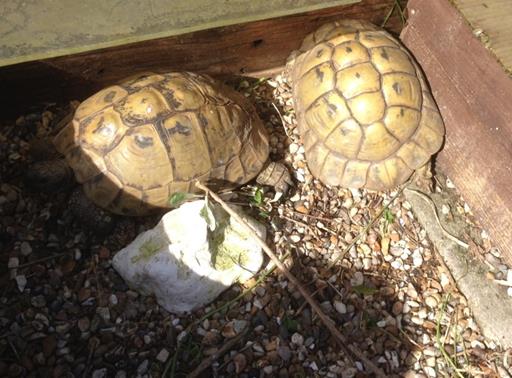
Examples of Mediterranean tortoises

Hermanns tortoise

Marginated tortoise

Spur-thighed tortoise


TBI

Plastron


All content © www.tortoisesoutheast.co.uk 2010
All rights reserved.